First, do not confuse the Olavs
At the centre of Trondheim, Olav Tryggvason stands high above the market square. A short walk away, Nidaros Cathedral rises over the traditional burial place of Olav Haraldsson—St. Olav. Visitors understandably blend them into one story. Trondheim makes more sense when we separate them.
Olav Tryggvason
The Viking king whom saga tradition credits with founding the town in 997. His monument now marks Torvet, Trondheim's central square.
Olav Haraldsson
The king killed at Stiklestad who became Norway's national saint and transformed Nidaros into a major pilgrimage destination.
One Olav gave Trondheim its founding story. The other gave Nidaros a sacred gravity that drew travellers across Northern Europe.
The ambitious founder
According to saga chronology, Olav Tryggvason founded the trading settlement at the mouth of the Nidelva in 997. The tradition is powerful, though historians are careful: activity and merchant buildings may have existed here before his reign.
The location was a natural meeting point. The sheltered river connected fjord, hinterland and sea routes. Here a ruler could gather trade, build authority and establish a royal presence. The settlement became known as Kaupangen and later Nidaros—the town at the mouth of the River Nid.
Olav Tryggvason ruled Norway for only a few years and died around the year 1000. Yet the image of the warrior and Christianising king remained. Today his statue looks down the axis of Munkegata, with Nidaros Cathedral in one direction and Munkholmen beyond the fjord in the other.
The warrior who became a saint
Olav Haraldsson was a Viking warrior before he became king. He ruled Norway from 1015 to 1028 and pursued the formation of a Christian kingdom. Political opposition drove him into exile, and he returned to claim power in 1030.
He was killed at the Battle of Stiklestad on 29 July. His body was taken to Nidaros and buried beside the Nidelva. Stories of miracles followed. A year and five days after the battle, the grave was opened and Olav was declared a saint.
His shrine drew pilgrims, and a church grew over the burial place. Construction of the great stone cathedral began around 1070. The king who had lost his earthly battle became Norway's “eternal king,” and Nidaros developed into one of Northern Europe's most important pilgrimage destinations.
The city is built in layers
Trondheim's oldest streets do not reveal everything at eye level. Beneath shops, squares and modern floors lie traces of earlier buildings, fires, streets and churches. Excavations in the city centre have found several church structures built one above another.
This makes the past less tidy—and more interesting. Saga, archaeology and later tradition do not always agree perfectly. A good city walk makes room for both the stories people carried forward and the questions the ground still asks.
History works best at walking pace
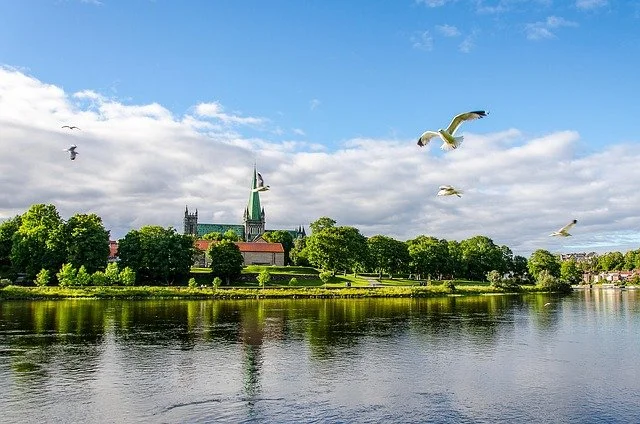
The distance between Torvet and Nidaros Cathedral is short. The historical distance is enormous. On foot, the relationship becomes visible: royal monument, reconstructed city plan, medieval sacred centre, river and the traces of the old kaupang.
Walking also allows us to notice the quieter evidence: names in the streets, the direction of an old route, a view framed by later buildings and the way the Nidelva still shapes the centre.
Our guides do not present Trondheim as a finished list of dates. We tell it as a city made by people—ambitious rulers, craftspeople, merchants, pilgrims and ordinary residents—whose choices remain beneath the Trondheim we use today.
The stories of the two Olavs are not the whole history. They are the doorway. Once you can tell the founder from the saint, the city begins to open.