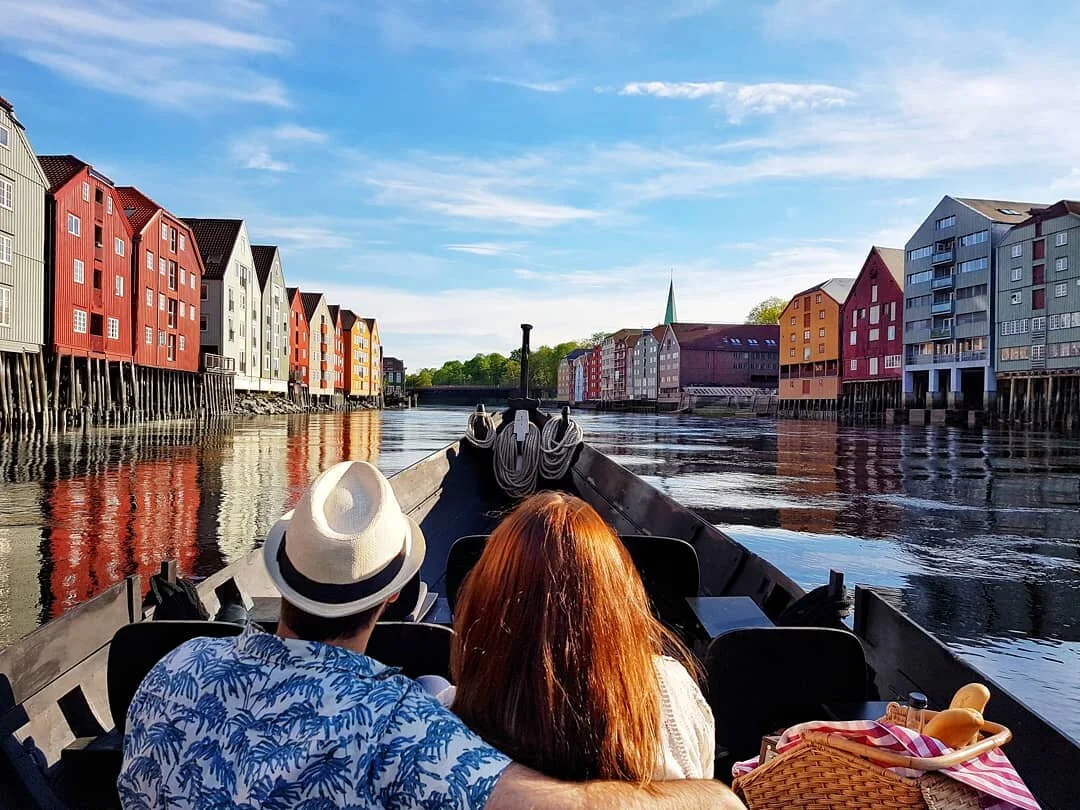
The city turns towards you
Trondheim grew where river and fjord meet. From the water, that relationship is visible at once: the colourful timber warehouses stand at the edge, bridges frame new views and the city feels close without feeling hurried.
A small boat follows the curves of the Nidelva instead of the logic of streets. Guests can look up rather than watch traffic, hear the guide without a crowd pressing past and notice how old trading routes still shape the modern centre.
Our three open wooden boats are working vessels. Frøya, Himinglæva and Bylgja move through the canal, under the bridges and along the old warehouses—carrying guests on the route people used long before roads shaped everyday life.
The water is not simply a viewpoint. It is the old road into Trondheim—and one of the calmest ways to understand the city.
Meet the fleet
Frøya
Åfjordsbåt · 1994Built by traditional boatbuilder Einar Borgfjord in 1994, Frøya is an Åfjordsbåt from the boat tradition of the Trøndelag coast. She is approximately 30 feet long and 2.8 metres wide, with the light, open character associated with boats made for these waters.
Today she has passenger benches and a 20 hp Yamaha outboard placed in a well. The well is the only permanent intervention in the traditional hull; the seating can be removed. Her mast and sail remain part of her identity, even though daily tours normally run under engine.
Himinglæva
Hardanger notbåt · late 1800sHiminglæva is a pointed-stern net boat brought from Hardanger. Built in the latter half of the nineteenth century, she carries roughly 150 years of working-boat history in her planks. At approximately 29 feet long and 3.8 metres wide, she is broad, generous and steady.
Boats like this were working tools for fishing communities. Himinglæva now carries visitors instead of nets, powered by a 20 hp Yamaha in a well, but her form still tells us what she was built to do.
Bylgja
Sørlandsk kogg · 1960Bylgja is a 29-foot clinker-built pine kogg, built at Georg Mustad's boatyard in Langesund around 1960 for Dalen Portland Cementfabrik, later Norcem. For about ten years she transported personnel out to large freighters near Brevik.
In the early 1970s she entered a fisherman's working life in Porsgrunn and remained a working boat until 2018. After a period as a leisure boat in Telemark, she travelled from Stathelle to Trondheim in October 2024. Her freshwater-cooled 10 hp Sabb engine dates from 1968. Once a carrier of workers and fishers, she now carries guests and stories.
Names carried in from Norse waters
The names connect the fleet not only to geography and craft, but to an older northern imagination of the sea.
One goddess and two daughters of the waves
Frøya takes her name from one of the most important goddesses in Norse mythology. A member of the Vanir, she is associated with love, fertility, magic known as seiðr, and death. Her name carries strength, knowledge and life—not merely beauty.
Bylgja and Himinglæva belong to the same mythological family. They are named among the nine daughters of Ægir and Rán, the great personifications of the sea. The daughters themselves personify waves. Bylgja can be understood as “the billowing one” or simply a wave, while Himinglæva evokes a sea so clear that the heavens are reflected in it—“heaven-bright” or “heaven-clear.”
The pairing feels fitting. One name holds the movement and force of a wave; the other holds the light above it.
The lines that connect them
Although their shapes and histories differ, all three are built in the Nordic clinker tradition. Each plank overlaps the next and is fastened along the seam, creating a hull that is light, flexible and strong. It is a building principle with more than a thousand years of continuity in the Nordic region.
UNESCO's recognition belongs to the Nordic clinker boat traditions—the knowledge, skills and social practices around building and using these boats—not to our company or to the individual vessels. Our responsibility is therefore practical: keep the boats in use, maintain them properly, employ people who learn their behaviour and invite new generations aboard.
The engines, wells and removable benches allow historic boat forms to work safely in a modern visitor economy. That balance is not the end of tradition. It is one way tradition remains useful enough to survive.
The conversation continues in Strekk seil
Cultural heritage viewed from the present
Millan Skjærbusdal contributes to the 2026 book Strekk seil – for nordlandsbåten og norsk klinkbåttradisjon, edited by Kjell Magne Mælen. The collection looks back at the clinker boat's history and social role, honours the knowledge of traditional boatbuilders, and—most importantly for our work—asks how building, maintenance and active use can be secured for the future.
Being part of that book places Trondheim by Boat within a wider discussion about living cultural heritage. The challenge is not simply to admire old vessels. It is to make room for their skills, maintenance, stories and use in today's communities and economy.
That is what happens each time one of our boats leaves the quay. A century-old fishing boat, a coastal boat built by a living tradition bearer and a southern workboat share the same river. Their histories remain different, but the water gives them a common future.
Boat specifications and histories are based on Trondheim by Boat's own vessel records and earlier company descriptions. Mythological interpretations follow established accounts of Frøya and the nine wave daughters of Ægir and Rán. Book details refer to the 2026 edition of Strekk seil, published by Kunkul.